
AVN Stages and Grades Explained (1 to 4)
Avascular Necrosis (AVN) of the hip does not happen all at once. It moves through four grades, from tiny bone damage you cannot feel, to complete collapse of the hip joint. Your grade decides your treatment, and your chances of saving your natural hip.
Doctors use grading systems with technical names like Ficat-Arlet and ARCO. To keep things simple, we explain everything as Grades 1 to 4.
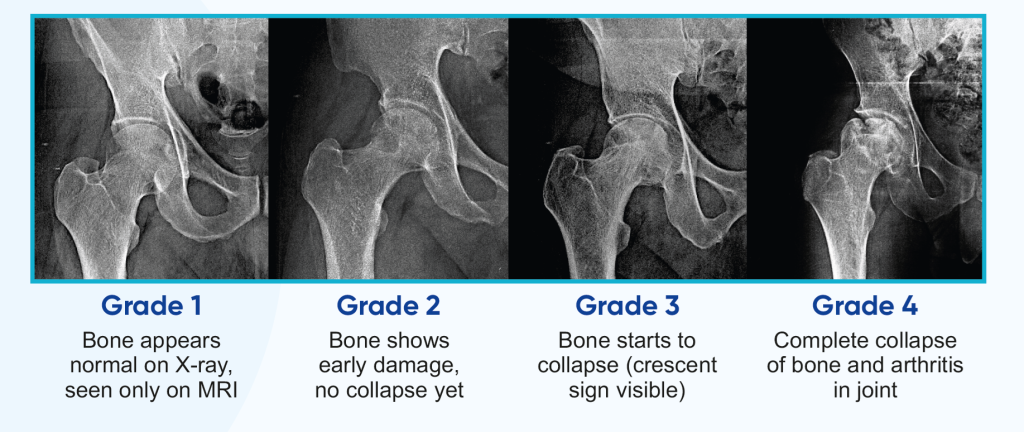
Grade 1: Early AVN (visible only on MRI)
What is happening in the bone: Blood supply to part of the femoral head (the ball of your hip joint) has been cut off. Bone cells are starting to die, but the bone still holds its normal round shape. An X-ray looks completely normal at this stage, only an MRI scan can see the damage.
What you feel: Often nothing at all. Some people feel a mild, on-and-off ache in the groin or hip after activity.
Best treatments: This is the golden window. Regenerative options like SVF therapy work best here, supported by medications and physiotherapy. Many Grade 1 hips can heal and never need surgery.
Grade 2: Bone Weakening (visible on X-ray, no collapse)
What is happening in the bone: The dead area of bone is now weakening. X-rays start to show patchy changes, some areas look denser, some look thinner (doctors call these sclerosis and cysts). The femoral head is still round. The joint surface has not broken.
What you feel: Pain in the hip or groin during walking, standing, or climbing stairs. The pain usually eases with rest. Some stiffness may begin.
Best treatments: The hip can still be saved. SVF therapy remains very effective. Core decompression with BMAC is also an option at this grade. Acting now, before collapse, makes a huge difference.
Grade 3: Early Collapse of the Femoral Head
What is happening in the bone: The weakened bone has started to give way. A thin fracture line appears just under the joint surface, on X-ray this is called the crescent sign. The femoral head begins to flatten. The joint no longer moves as smoothly.
What you feel: Persistent pain, even at rest and at night. A visible limp. Difficulty sitting cross-legged or squatting. Reduced hip movement.
Grade 3A vs 3B: Doctors split this grade in two. In 3A (early), the collapse is small (under about 2 mm) and joint-saving treatment like SVF therapy may still work. In 3B (late), the flattening is larger and hip replacement becomes more likely. An MRI review tells you which side of the line you are on.
Best treatments: Early Grade 3, regenerative therapy or core decompression + BMAC, judged case by case. Late Grade 3, hip replacement gives more reliable relief.
Grade 4: Complete Collapse and Arthritis
What is happening in the bone: The femoral head has collapsed and lost its round shape. The cartilage on both sides of the joint wears away, and the hip develops secondary arthritis. The damage at this stage cannot be reversed by any medicine or injection.
What you feel: Severe, constant pain. Major difficulty walking. Marked stiffness, daily activities like wearing footwear or using stairs become hard.
Best treatments: Total hip replacement is the most effective option at this stage. It removes the damaged joint and gives excellent, long-lasting pain relief. Supportive care helps manage symptoms while you prepare for surgery.
Which treatment fits my grade?
| Grade | What's happening | Best options |
|---|---|---|
| Grade 1 | Bone damage visible only on MRI; no pain or mild ache | SVF therapy, medications & physiotherapy |
| Grade 2 | Bone weakening on X-ray; pain with activity; no collapse | SVF therapy, core decompression + BMAC |
| Grade 3A | Small early collapse (crescent sign); persistent pain, limp | SVF therapy (case by case), core decompression + BMAC |
| Grade 3B | Larger collapse; joint surface failing | Hip replacement usually advised |
| Grade 4 | Complete collapse with arthritis; severe constant pain | Total hip replacement + supportive care |
Why your grade matters so much
Every grade you slip costs you options. At Grade 1 and 2, most hips can be saved without major surgery. By Grade 4, replacement is usually the only reliable answer. The difference between those outcomes is often just a few months of waiting.
If you have hip pain and any AVN risk factor, steroid use, heavy alcohol, a hip injury, or a past COVID hospital stay, get an MRI and find out your grade now. Read more in our guide to the stages of AVN or the complete AVN treatment guide.
Not Sure of Your Grade? We'll Tell You: Free.
Send us your details and we will call you back. We review your MRI report, confirm your AVN grade, and explain which treatments genuinely fit your stage, in simple language, with no obligation.
- Free MRI report review
- Clear answer on your grade (1, 2, 3A, 3B or 4)
- Stage-wise treatment guidance
We do not provide telemedicine. All medical consultations happen in person at certified facilities.
Request a Call Back
Fill this in, it opens WhatsApp with your details ready to send.
AVN Stages: Frequently Asked Questions
Can AVN stay at one stage without getting worse?
Sometimes, but it is rare. Most untreated AVN slowly moves to the next grade. Small areas of damage progress more slowly, and treatment in the early grades can stop or even reverse the damage. This is why doctors repeat MRI scans to watch for change.
How fast does AVN progress from Grade 1 to Grade 4?
It varies from person to person. Without treatment, many hips move from early AVN to collapse within 6 months to 2 years. Larger areas of dead bone and continued risk factors like steroids or alcohol speed this up. Early treatment slows or stops progression.
Can Grade 3 AVN avoid hip replacement?
Often yes, in early Grade 3 (3A), when the collapse is small and the joint surface is mostly intact. Regenerative options like SVF therapy can still help. In late Grade 3 (3B) and Grade 4, the bone shape is too damaged, and hip replacement usually gives the best result.
Which test tells me my exact AVN grade?
An MRI scan is the most accurate test for grading AVN, especially in early stages when X-rays look normal. In later grades, X-rays also show the collapse. A specialist reads both together to confirm your grade.
Is Grade 4 AVN an emergency?
It is not a life-threatening emergency, but you should not delay treatment. The longer a collapsed hip is used, the more the surrounding muscles weaken and the other joints strain. Timely hip replacement restores mobility and quality of life.
Do both hips always get AVN?
No, but AVN affects both hips in roughly half of steroid-related cases. If one hip has AVN, doctors usually scan the other hip too, because catching the second hip at Grade 1 gives the best chance of saving it.
Know Your Grade. Save Your Hip.
Every month of delay can move you one grade closer to hip replacement. Get a free review of your MRI report today and find out exactly where you stand.
Call for Free Consultation WhatsApp Us