
Avascular Necrosis (AVN) of the hip does not happen overnight. It moves through stages, from invisible damage deep inside the bone to complete collapse of the joint. Knowing your stage is the single most important fact in your treatment journey, because the stage decides which treatments can still save your hip.
This guide explains all four stages in simple language. For an even deeper page-by-page breakdown, see our full guide to AVN stages and grades.
Quick refresher: AVN means part of the femoral head (the ball of your hip joint) is dying because its blood supply is blocked. New to the condition? Start with What is Avascular Necrosis?
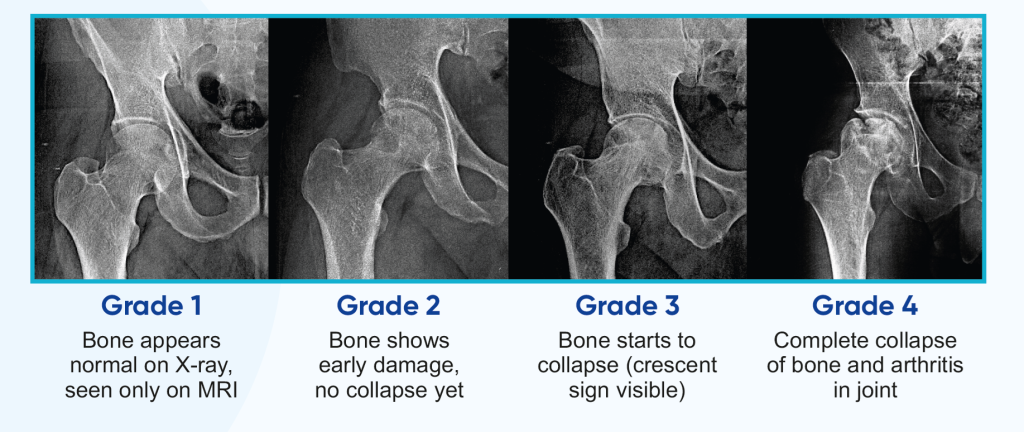
Stage 1: Silent damage (MRI-only stage)
What is happening in the bone: A patch of bone inside the femoral head has lost its blood supply and started to die. The bone still looks and feels normal from outside. X-rays look completely normal.
What you feel: Often nothing. Some people have mild, on-and-off ache in the groin or hip after activity.
Treatment: This is the golden window. Regenerative options like SVF therapy work best here, supported by lifestyle changes and physiotherapy. Many Stage 1 hips can be saved completely.
Stage 2: The bone weakens (visible on X-ray)
What is happening in the bone: The dead patch is now large enough to change the bone's internal structure. X-rays start showing patchy dense and hollow areas. Crucially, the femoral head still keeps its round shape.
What you feel: Pain with walking, standing, or climbing stairs. It often eases with rest.
Treatment: Hip preservation is still very possible, SVF therapy or core decompression with BMAC, chosen based on your MRI.
Stage 3: The surface starts to collapse
What is happening in the bone: The weakened bone can no longer hold its shape. A thin fracture line (the "crescent sign") appears under the joint surface, and the surface begins to flatten. Doctors often split this stage into 3A (early, minimal collapse) and 3B (late, clear collapse).
What you feel: Persistent pain, even at rest. A limp usually appears. Sitting cross-legged becomes difficult.
Treatment: In 3A, regenerative treatment may still save the joint. In 3B, options narrow, and hip replacement starts entering the conversation. This is the stage where getting an expert MRI review quickly matters most.
Stage 4: Collapse and arthritis
What is happening in the bone: The femoral head has collapsed and lost its round shape. The damaged ball grinds against the socket, wearing out the cartilage. This is secondary arthritis of the whole joint.
What you feel: Severe, constant pain. Badly reduced movement. Walking distances shrink month by month.
Treatment: Once the joint surface is destroyed, no injection or drilling can rebuild it. Total hip replacement is usually the most reliable answer, and modern implants give excellent, long-lasting results.
Stage-by-stage summary
| Stage | What's happening | Typical symptoms | Best treatment options |
|---|---|---|---|
| 1 | Bone dying inside; visible only on MRI | Mild or none | SVF therapy, supportive care |
| 2 | Bone weakening; shape still intact | Pain with activity | SVF therapy, core decompression + BMAC |
| 3 | Early collapse of the surface (3A → 3B) | Persistent pain, limp | 3A: regenerative options may work · 3B: consider replacement |
| 4 | Full collapse + arthritis | Severe constant pain | Hip replacement |
What decides how fast AVN progresses?
- How early it was caught. Small Stage 1 lesions behave very differently from large Stage 2 ones.
- Whether the cause continues. Ongoing steroid use or alcohol keeps damaging the blood supply. Learn more about AVN causes.
- Load on the hip. Heavy work, high-impact activity, and excess body weight speed up collapse.
- Treatment adherence. Skipping follow-up MRIs means stage changes get missed.
MRI vs X-ray for staging
An MRI detects AVN in Stage 1, when X-rays are still normal. If you have unexplained hip or groin pain, especially with risk factors like steroid use, a normal X-ray is not enough to rule AVN out. Our guide to AVN diagnosis explains exactly what each scan shows.
Not sure of your stage? Send us your MRI report and we will explain it in simple words, free of charge. Call +91 82230 82900, or read the Complete AVN Treatment Guide and our article on treating AVN without surgery first.